Reflection on a brief occupation

I visited Occupy Winnipeg today.  With nights already dipping below freezing I had one initial question on my mind.  The answer is yes.  They are preparing for winter.  I only spent about hour at the site chatting with a few individuals.  After biking away, alone now with my impressions, I came to the confession that it is and would be quite easy to mock this local expression.  My conversations were peppered with grasping sentiments about being connected to something larger, vague allusions to support from people with power, comments about getting good press, politically correct placating, bitching against the Man, and some straight-up bullshit.

I would not be surprised if the greatest immediate need this expression fulfills is to have egos rubbed both for people who are valiantly braving the cold in support of justice and also for others who can bring a pot of hot chili and bag of sweaters to feel good about supporting the cause.  Why do I say this?  Do I say this to discredit them or the expression?  I call this a confession simply because it is being honest with my perception and experience. I do not want to create from nothing hopes and notions that do not relate to reality.

And this initial step of confession is important, for myself in any event.  It is important because of the presence of another element I encountered.  What troubled me reflecting on the ‘spirit’ of the people there were the resources  being drawn upon for hope.  One person talked about being connected to something epic another sensed the significance of what was happening, others appealed to the power of vague traditions.  Some dropped ambiguous allusions to the ‘lawyers and doctors’ connected to their cause.  One even said the provincial government ‘supported them’.  In fairness, there was also clear acknowledgement that this is, at the local level, starting from scratch.  They are not even beginning.  They are trying to figure out how to begin.  At this point they are gathering.  And it is a diverse and motivated gathering.  And this I support.

I have struggled with the banner of ‘We are the 99%’.  Perhaps it really is the best possible rallying cry to bring these diverse groups together.  But I struggle with it because of those who do not even factor into the equation.  I am thinking of two experiences I had in the last two days.  One was witnessing a person steal three boxes of diapers (no small accomplishment and no doubt accompanied by no small amount of nerve or desperation).  The other was seeing a neighbourhood kid I have gotten to know riding around on the sidewalk with a bike that had a flat tire and no seat.  Both events stirred that experience of not knowing whether I would laugh or cry if I were to express my emotions.  It is almost comedic in its tragedy and definitely tragic in its comedy.  It is the refuse and rejection of our society.  For me it was encountering the ones that do not have a place holder in the calculation of percentages.  In both instances the people involved were First Nations females.

If there was to be some hope that I took from visiting Occupy Winnipeg it was that there were a number a First Nations women present (a relatively high proportion in a small overall number).  As I stood there not really instigating any conversation one of them simply poured out her life dramatic fashion.  I have experienced enough to call this a dramatic telling not to question whether or not it is factual but to recognize that tragedy  has become one of a limited number of modes of communicating that some people seem capable of engaging in.  But it appears at this site the unrepresented and uncounted are finding some sort of representation.  And that is a good thing.  When my church gathers to occupy our sanctuary I have not encountered the drawing out of the unrepresented.  This is not such a good thing.

Soren K meet Chuck D; Or, How you sell soul to a soulless people who sold their soul

Kierkegaard’s Upbuilding Discourses have not always been engaging but they have offered what I think is a helpful corrective or supplement to much of my contemporary reading.  I hope to post more on some earlier discourses but I am now about halfway through the eighteen and have come across his reflections on the soul, namely how to gain and preserve your soul in patience.

Continue reading “Soren K meet Chuck D; Or, How you sell soul to a soulless people who sold their soul”

Did you wish . . . could you wish

Either / Or concludes with Judge William offering the transcript of sermon he received from a friend who is a minister.  William is convinced that this sermon reflects what he had been straining towards in his letter (which is what all of vol 2 is considered).  The minister has yet to preach this sermon but believes in time that he will be able to have his entire congregation understand it “for the beauty of the universal consists precisely in the fact that all can understand it.”

Continue reading “Did you wish . . . could you wish”

Attention Please

I have increasing appreciation for Philip Goodchild’s notion of attention as our mode of piety.  His premise of course is that money is our God demanding our attention in nearly all aspects of life.  I can’t help but think of the power of attention when I look at the protests in Cairo.  I have no insight into the actual issues themselves but I can see the effect of a mass turning of attention, a mass crystallizing of focus, on a particular issue.

Introduction to Louis Riel and His Philosophical Theology

[Update: For those who may be interested in following this I have included a link to these posts in the ‘Translation Projects’ tab.]

Louis Riel was a Metis Canadian born in 1884 near Winnipeg Manitoba, Canada.  He was the leader of two resistance movements that attempted to preserve Metis rights in the face of the expanding Canadian government in the East.  I do not pretend to be a Riel expert nor do I consider myself particularly knowledgeable of the political context for the expansion of Canada.  However, I do know the following;

Louis Riel is a controversial figure.  He has been described as a hero, revolutionary, lunatic, self-proclaimed messiah and traitor.  Louis Riel was a deeply religious man.  Louis Riel attempted to promote an alternative politics in the face of the monopolizing government and Hudson’s Bay Trading Company.  In the process he established a provisional government in Manitoba in opposition to the Canadian government in the East.  Riel continued this pursuit in the face of extreme resistance.  Riel received capital punishment for his actions.  Riel is part of my local history.

This scant information has provided enough motivation to seek out his writings to find if there are any explicitly theological tracts.  In his Collected Works I have come across a short section that includes fragments he called a ‘philosophical theology’ in French.  So far as I know these are untranslated.

While there is a book on Riel as a religious man, Louis ‘David’ Riel: Prophet of the New World, there is no substantial study of his theology in relation to his politics in English.  There is one work in French that I hope to eventually give some attention.  This is Gilles Martel’s, Le messianisme de Louis Riel.

My intention is to slowly offer his Système philosophico-théologique in translation (it is only 12 pages of fragments).  I have no idea what this pursuit might offer but it seems helpful to at least render more of Riel’s French writing into English.  It also seems helpful to look over these writings (in addition to his occasional writing relevant to his theology) with a more thoroughgoing theological attention than has been given.

Romans 13 – An Agambenian Reading

Romans 13 has long been a thorn in my Anabaptist side.  Yoder of course went a long way in clarifying the distinction between being subject to those in authority and actually obeying those in authority.  That reading however still left me with many unanswered questions as to what Paul is calling the church towards.  In preparation for the Romans readings of this season of Advent I reread Giorgio Agamben’s The Time that Remains.  In this reading the notion of messianic time functioning as “the time of bringing time to an end” became more clear and relevant as I was reading through Romans alongside his work.  I interpret the structure of the world’s authority as functioning as a sort of limit to the mode in which humanity lives apart from the Spirit.  As such the kingdom of the world is and will be coming to an end.  This becomes significant for reading Romans 13.  What struck me was the simple Greek structure of verse 7
ἀπόδοτε πᾶσιν τὰς ὀφειλάς,
τῷ τὸν φόρον τὸν φόρον,
τῷ τὸ τέλος τὸ τέλος,
τῷ τὸν φόβον τὸν φόβον,
τῷ τὴν τιμὴν τὴν τιμήν.
Pay back every debt
for tax, tax
for revenue, revenue
for fear, fear
for respect, respect
Then Paul adds significantly in verse 8,
Μηδενὶ μηδὲν ὀφείλετε
Be in indebted to no one for anything (I can’t comment on the double-negative in Greek here; I suspect it is common)
The process of relating to earthly authorities is that of closing down their economy, of divesting yourself of its structure (which is different than escaping it).  The work then is not of revolt (necessarily) which is why this passage can be confused for quietism but rather that of rendering it inoperative an important Pauline term that Agamben stresses.  I read this in light of Kierkegaard’s commentary on Paul’s And having overcome all, to stand.  Much of our effort exists directly in relationship to opposition.  Opposition in many cases is absolutely necessary for the existence of our work.  I need the machine to rage against it.  This is a reductionist characterization to be sure but I can’t help think of how many movements will simply fall down when the powers are removed from their pushing.  In any even I take Paul to be doing something different than direct revolt.  This does not necessarily clarify what we should then do with this reading but it demands that we not acquiesce to earthly authority but that we are continually in the active process of liberating ourselves and others from indebtedness.
To the extent that you are invested in this world whether tax, debt, fear or honour pay it back in kind so that all that remains in practice is the opening of love and not the foreclosure of debt.  The work of this ‘flesh’ will continually be present in a humanly inescapable manner (who will rescue me from this body of death).  We become though tools of light which cut through and create a division within the divisions of this world that constantly undermine and deactivate them.  This is all exegetical rhetoric at this point.  I have no idea what sort of tool I will function as what it demands though is that no position within world renders spiritual impossible.  No system is dominant that it can, by its force, reclaim the new creation of the Messiah.  This problematizes the typical leftist project as I would see it which continually stresses system as that which binds and liberates (though it does that at a certain level).  I read this text and larger Pauline theology (in light of Agamben) as one which always supposes the freedom of the individual so that she might work within the place of her calling (and in communion with the saints) dividing the divisions and use this time for bringing time to an end.

Image as Everything

Thanks to zunguzungu for clarifying some important points in my last post.  That image raises the ongoing question of the image’s power or value.  The image in the previous post shows a cop with what almost looks like a posture of fear facing some unknown and unseen presence (surely he is justified in the face of what must be horrible).  Even the hippie in the background looks taken off guard.  Perhaps we should have re-thought this. Then below you have a burly police officer looking like he is about to put the full force of authoritarian stick into the gut of some un-sporty student who just wants to get inside the hallowed halls of academia.


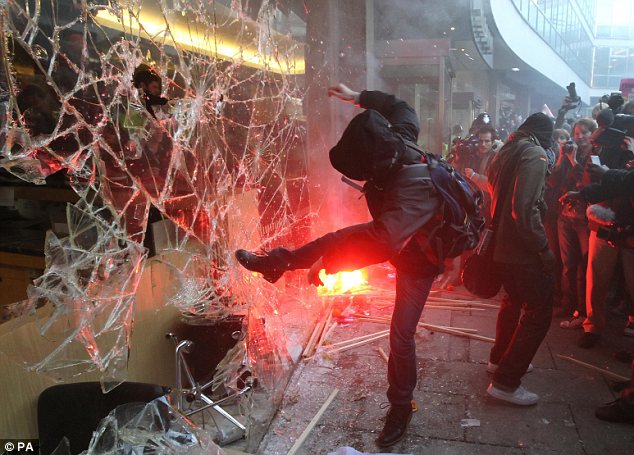
This reminds me of the also recent student protests in England (50,000 + I am told).  ads without products offers these two images.

And then a wider frame.

I am sure this issue has many well-worn conversation paths that I am not aware of.  But I am a consumer of these images far and above being a critic and participant in understanding the issues at hand.  Is it simply another form of Capitalism-as-Universal in which these expressions are immediately captured in the lenses of those who will in turn profit from portraying all parties in all lights to ensure maximum return?