Book Review – Anarchy and Apocalypse

Ronald E. Osborn. Anarchy and Apocalypse: Essays on Faith Violence, and Theodicy (Cascade Books, 2010).

Osborn’s short collection of essays is one of the more eclectic publications I have read in some time.  Faith and violence are indeed the mingled themes that bind this work together; having said that, however, the collection is somewhat nomadic moving from shorter almost op-ed pieces to longer more technical engagements.  Osborn’s introduction claims that a possible underlying ‘project’ here is an attempt to relate anarchist and Christian approaches to nonviolence.

Continue reading “Book Review – Anarchy and Apocalypse”

Romans 13 – An Agambenian Reading

Romans 13 has long been a thorn in my Anabaptist side.  Yoder of course went a long way in clarifying the distinction between being subject to those in authority and actually obeying those in authority.  That reading however still left me with many unanswered questions as to what Paul is calling the church towards.  In preparation for the Romans readings of this season of Advent I reread Giorgio Agamben’s The Time that Remains.  In this reading the notion of messianic time functioning as “the time of bringing time to an end” became more clear and relevant as I was reading through Romans alongside his work.  I interpret the structure of the world’s authority as functioning as a sort of limit to the mode in which humanity lives apart from the Spirit.  As such the kingdom of the world is and will be coming to an end.  This becomes significant for reading Romans 13.  What struck me was the simple Greek structure of verse 7
ἀπόδοτε πᾶσιν τὰς ὀφειλάς,
τῷ τὸν φόρον τὸν φόρον,
τῷ τὸ τέλος τὸ τέλος,
τῷ τὸν φόβον τὸν φόβον,
τῷ τὴν τιμὴν τὴν τιμήν.
Pay back every debt
for tax, tax
for revenue, revenue
for fear, fear
for respect, respect
Then Paul adds significantly in verse 8,
Μηδενὶ μηδὲν ὀφείλετε
Be in indebted to no one for anything (I can’t comment on the double-negative in Greek here; I suspect it is common)
The process of relating to earthly authorities is that of closing down their economy, of divesting yourself of its structure (which is different than escaping it).  The work then is not of revolt (necessarily) which is why this passage can be confused for quietism but rather that of rendering it inoperative an important Pauline term that Agamben stresses.  I read this in light of Kierkegaard’s commentary on Paul’s And having overcome all, to stand.  Much of our effort exists directly in relationship to opposition.  Opposition in many cases is absolutely necessary for the existence of our work.  I need the machine to rage against it.  This is a reductionist characterization to be sure but I can’t help think of how many movements will simply fall down when the powers are removed from their pushing.  In any even I take Paul to be doing something different than direct revolt.  This does not necessarily clarify what we should then do with this reading but it demands that we not acquiesce to earthly authority but that we are continually in the active process of liberating ourselves and others from indebtedness.
To the extent that you are invested in this world whether tax, debt, fear or honour pay it back in kind so that all that remains in practice is the opening of love and not the foreclosure of debt.  The work of this ‘flesh’ will continually be present in a humanly inescapable manner (who will rescue me from this body of death).  We become though tools of light which cut through and create a division within the divisions of this world that constantly undermine and deactivate them.  This is all exegetical rhetoric at this point.  I have no idea what sort of tool I will function as what it demands though is that no position within world renders spiritual impossible.  No system is dominant that it can, by its force, reclaim the new creation of the Messiah.  This problematizes the typical leftist project as I would see it which continually stresses system as that which binds and liberates (though it does that at a certain level).  I read this text and larger Pauline theology (in light of Agamben) as one which always supposes the freedom of the individual so that she might work within the place of her calling (and in communion with the saints) dividing the divisions and use this time for bringing time to an end.

A Call for Theo-political Readings

I was sent a link to the following youtube video.  The Messiah continues to strike me as an overwhelmingly political statement and given the context and players involved in this video I started feeling great dissonance.  Was the kingdom of this world becoming the kingdom of our Lord and of his Christ through irruptive means?  Was the kingdom of Lord and of his Christ reified as a free toy for your food court meal?  I welcome readings to clear the dissonant and disturbing sounds still ringing my ears.

Image as Everything

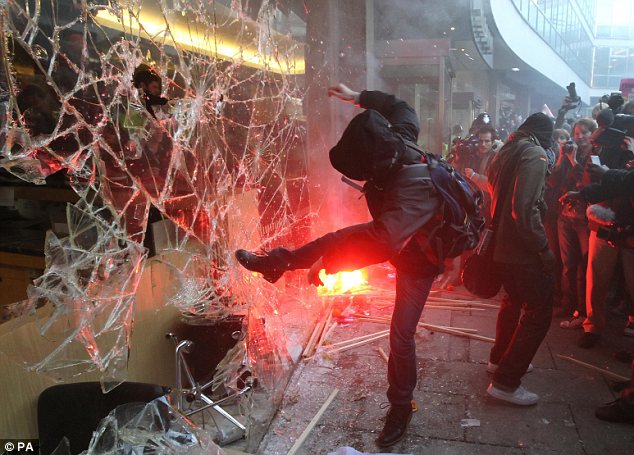
Thanks to zunguzungu for clarifying some important points in my last post.  That image raises the ongoing question of the image’s power or value.  The image in the previous post shows a cop with what almost looks like a posture of fear facing some unknown and unseen presence (surely he is justified in the face of what must be horrible).  Even the hippie in the background looks taken off guard.  Perhaps we should have re-thought this. Then below you have a burly police officer looking like he is about to put the full force of authoritarian stick into the gut of some un-sporty student who just wants to get inside the hallowed halls of academia.


This reminds me of the also recent student protests in England (50,000 + I am told).  ads without products offers these two images.

And then a wider frame.

I am sure this issue has many well-worn conversation paths that I am not aware of.  But I am a consumer of these images far and above being a critic and participant in understanding the issues at hand.  Is it simply another form of Capitalism-as-Universal in which these expressions are immediately captured in the lenses of those who will in turn profit from portraying all parties in all lights to ensure maximum return?

The Gospel According to Adam Kotsko; And a Kotskotian Conspiracy

I recently checked the price of Adam Kotsko’s recent book The Politics of Redemption and fortunately it came up with “Look Inside” feature.  I came across a content and tone of writing that may not regularly surface over at AUFS (note well that I am saying nothing of how the two forms relate . . . yet).

Christ restores connections that have been cut off, yet he doesn’t repeat the logic of possession by trying to control those he encounters.  He forgives sins, but is remarkably reticent about how the forgiven should behave in the future, reflecting how often “sin” functions as a stigma rather than a good-faith moral assessment.  He is chastised for his self-indulgence, and in his interactions with others, he very often seems to playing with them.  His persuasiveness is therefore based not on rational argument, but first of all on his general way of being in the world – his simply willingness to be with people whom others shun or simply ignore, his evident enjoyment of them.  His way of being does not end just with him, but spreads to others as a kind of “contagious sovereignty,” an empowerment that is predicated on empowering others rather than dominating them.  Several of those he empowers are sent immediately to continue the work among their own people, implying that no implicit instruction is needed.  His actual public teaching fits within this general pattern, mobilizing surprise in order to invite his readers to come to their own conclusions, a technique that is perhaps also motivated by the sheer pleasure that accompanies an unexpected narrative or discursive twist.  Perhaps the clearest indication of Christ’s approach is the feeding of the multitude, where simple generosity and sharing result in a wholly unanticipated abundance.

Pages started breaking up too far apart to continue reading with any coherence after this quote.

Two things struck me.  First this could have been plucked almost directly out of some of Jean Vanier’s works (especially content related to fear that surrounds this quote).  Secondly this quote led me to a conspiracy theory.  The Adam Kotsko of AUFS is a kierkegaardian pseudonym of the same name (to further nuance the matter) introducing an aesthetic form to the clear the way for his later moral and dogmatic expressions.  It all makes sense now!

The Good Neighbourhood

My wife and I recently purchased our first home.  The house is located in a neighbourhood of Winnipeg in which I have spent the vast majority of my adult Manitoba life.  Moving back from Ontario it was like coming back home.  I am referring to the Spence Neighbourhood in the West End of Winnipeg.  I have lived on Spence St, Young St and I now reside on Langside.  What is clear to me is that everyone, everyone from Winnipeg somehow knows this is a ‘bad’ neighbourhood.  This is so implicitly ingrained in my psyche that when I tell people where our house was I began to rationalize or justify or downplay our decision.  The truth is that I am not sure I can think of a more desirable neighbourhood to live in (maybe the Exchange District).  I love it here.  So I have decided to stop making any additional commentary when I tell people where our house is located.

What I have noticed (after the pause in conversation when I tell them) is that people are now filling in the justification for me or making explicit the public perception (One person actually asked, Isn’t that a scary neighbourhood?).  What is going on here?  Are people actually concerned about my safety?  Maybe.  Do people have a clue what this neighbourhood is actually like?  Probably not.  I would like to propose that maybe part of the need to react to my choosing and (of all things) embracing this neighbourhood is that it subtly questions dominant cultural motivations for home owning . . . namely fear.  In as much as people choose homes out of desires and preferences for this-that-and-the-other I found that house hunting played as much on my fears as anything else.  Will this place retain its value?  Is this a safe neighbourhood?  How will our house and neighbourhood reflect how people view us? These can quickly become dominant motivations as cities have driven for decades now away from the depraved city centres to faux Edens with green lawns, no sidewalks and high fences.

I recognize that our house purchase does not give me any moral high-ground in this larger conversation but our decision has exposed something in myself and seemingly in others.  Our decisions are caught up in a larger system in which we are all participants.  We affirm each other in our decision in live in a ‘good’ neighbourhood.  What defines a good neighbourhood?  I would venture the definition of a good neighbourhood as one in which I do not need to think about anything outside my immediate concerns.  A ‘bad’ neighbourhood then in is one in which outside concerns run in conflict to my own pattern of living.  Living in a ‘bad’ neighbourhood then becomes a call in itself to question our existing pattern of living.  It demands that I make explicit and conscious choices about the things that our world and society are being confronted with and how I am responding to them.  A good neighbourhood then is the capitalist dream.  It caters to my choice and provides the goods and services that will maintain my flow of interests and desires without obstruction.  So what is it again that is good about a good neighbourhood?

Debt, time, [and the new] wealth

Here is an extended quote from Franco Berardi’s The Soul at Work,

The postmodern domination of capitalism is founded on the refrain of wealth, understood as cumulative possession.  A specific idea of wealth took control of the collective mind which values accumulation and the consent of the postponing of pleasurable enjoyment.  But this idea of wealth (specific to the sad science of economics) transforms life into lack, need and dependence.  To this idea of wealth we need to oppose another idea: wealth as time – time to enjoy, to travel, learn and make love.

Economic submission, producing need and lack, makes our time dependent, transforming our life into a meaningless run towards nothing.  Indebtedness is the basis of this refrain.

In 2006, the book Generation Debt (subtitled: Why now is a terrible time to be young) was published in the United States.  The author, Anya Kamenetz considers a question that finally came to the forefront of our collective attention in 2007, but has been fundamental to capitalism for a long time: debt.

Anya Kamenttz’s analysis refers especially to young people taking out loans in order to study.  For them, debt functions like a symbolic chain whose effects are more powerful than the real metal chains formerly used in slavery.

This new model of subjugation goes through a cycle of capture, illusion, psychological submission, financial trap and finally pure and simple obligation to work.

. . .

Our young fellow signs the loan, goes to university and graduates: after that, his/her life belongs to the bank.  S/he will have to start work immediately after graduation, in order to pay back a never ending amount of money. . . . S/he will have to accept any condition of work, any exploitation, any humiliation, in order to pay the loan which follows her wherever s/he goes.

Debt is the creation of of obsessive refrains that are imposed on the collective mind.  Refrains impose psychological misery thanks to the ghost of wealth, destroying time in order to transform it into economic value.  The aesthetic therapy we need – an aesthetic therapy that will be the politics of the time to come – consists in the creation of dissipating refrains capable of giving light to another modality of wealth, understood as time for pleasure and enjoyment.

The crisis that began in the summer of 2007 has opened a new scene: the very idea of social relation as ‘debt’ is now crumbling apart.

The anti-capitalist movement of the future won’t be a movement of the poor, but of the wealthy.  The real wealthy of the future will be those who will succeed in creating forms of autonomous consumption, mental models of need reduction, habitat models for the sharing of indispensable resources.  This requires the creation of dissipative wealth refrains, or of frugal and ascetic wealth.

in the virtualized model of semiocapitalism, debt worked as a general frame of investment, but it also became a cage for desire, transforming desire into lack, need and dependency that is carried for life.

Finding a way out of such a dependency is a political task whose realization is not a task for politicians.  It’s a task for art, modulating and orienting desire, and mixing libidinal flows.  It is also a task for therapy, understood as a new focalization of attention, and a shifting of the investments of desiring energy.

There is No Oedipal Triangle

I am slowly and awkwardly making my way through Anti-Oedipus.  The process reminds me a little of my first venture through The Brothers Karamazov.  At many points I had the Russian names all jumbled, I had put it down for weeks at a time and then picked up wherever it was that I left off not entirely sure of just what I was entering back into.  It was through that process I came to realize that some books simply needed to be read once so that a basic orientation could be laid for a second reading.  Perhaps this is a lousy and ineffective reading strategy but it has helped sustain my spirit while plodding through books I did not understand (only later to be greatly enlightened by them).  In any event Delueze and Guattari’s Anti-Oedipus is of a similar but also entirely different order.  I rarely know just what the hell is going on.  There have been, however, enough intersections of clarity that offer themselves as tiny beacons to start charting rough waters.  I recently read one such section.

There is no Oedipal Triangle:  Oedipus is always open in an open social field.  Oedipus opens to the four winds, to the four corners of the social field (not even 3+1, but 4+n).  A poorly closed triangle, a porous or seeping triangle, an exploded triangle from which the flows of desire escape in the direction of other territories.  It is strange that we had to wait for the dreams of colonized peoples in order to see that, on the vertices of the pseudo triangle, mommy was dancing with missionary, daddy was being fucked by the tax collector, while the self was being beaten by the white man.  It is precisely this pairing of the parental figures with agents of another nature, their locking embrace similar to that of wrestlers, that keeps the triangle from closing up again, from being valid in itself, and from claiming to express or represent this different nature of the agents that are in question in the unconscious itself. . . . It could always be said that these extreme situations of war trauma, of colonization, of dire poverty, and so on, are unfavorable to the construction of the Oedipal apparatus – and that it is precisely because of this that these situations favor a psychotic development or explosion – but we have a strong feeling that the problem lies elsewhere.  Apart from the fact that a certain degree of comfort found in the bourgeois family is admittedly necessary to turn out oedipalized subjects, the question of knowing what is actually invested in the comfortable conditions of a supposedly normal or normative Oedipus is pushed still further into the background.

The revolutionary is the first to have the right to say: “Oedipus? Never heard of it.”

Anti-Oedipus, 96.

Introduction to After the Postsecular and Postmodern – Excerpts and Comments

For anyone interested, the editor’s Introduction for After the Postsecular and Postmodern is available at Scibd.  One of the editors and several of the contributors in this volume are regulars at AUFS.  As I started reading through it I thought I would past chunks that stood out or reflected the direction or intent of the volume (I have not yet seen a copy).  I have inserted a few comments, some of which are critical but of course they are then very provisional as I am working from something that points to a whole that I have not seen.  I have tried to keep the comments then on how this piece structures the project.

Continue reading “Introduction to After the Postsecular and Postmodern – Excerpts and Comments”