This Just In . . .

Christopher Hitchens and Tony Blair (really?) debated the role of religion in society in Toronto last night . . . this morning’s headlines,

Hitchens apparent winner in religion debate

Preliminary poll results show Hitchens winner of religion debate with Tony Blair
I have to say this blew a few gaskets over my morning coffee.  Yes let’s set the question of whether religion is divisive and destructive in the context of simplistic oppositions requiring the perception of a single winner . . . perfect.

Memorial Friday; Or, Black Friday of Death

In remembrance of the young man trampled to death opening the doors to a Wal-Mart during Black Friday 2008.

Listen to the crazy rhetoric of this piece.  There are a tonne of soundbites worth dissecting.  Look at the repetitious shots of the ‘gang’ of young black men standing around outside by the police cruiser.

Police were knocked over trying to give CPR to the man

The store reopened for shopping by noon

The cause of death was apparently ‘unclear’ at that point


Making a Sad Story Sadder

As though a story of sexual assault is not sad enough this is the description of the suspect as reported in the Winnipeg Free Press,

Police released the following description of the suspect. He is aboriginal in appearance, about 25 years old, approximately six-feet tall, weighing 120 pounds, with short, dark brown hair.

He has yellow teeth and was missing an upper tooth. He also had acne scars on his face.

Are there any parts of society that this person would not be alienated from?

Image as Everything

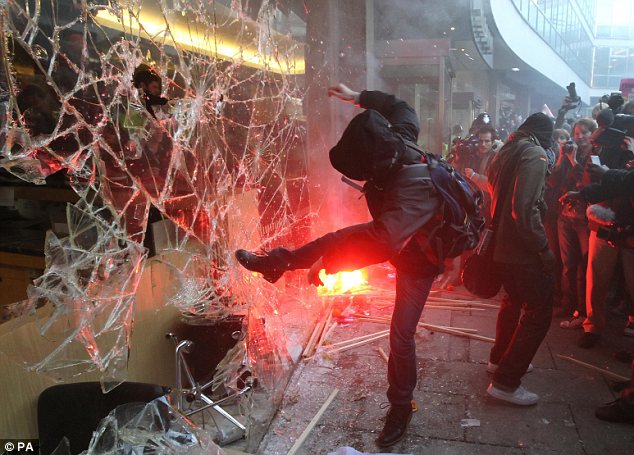
Thanks to zunguzungu for clarifying some important points in my last post.  That image raises the ongoing question of the image’s power or value.  The image in the previous post shows a cop with what almost looks like a posture of fear facing some unknown and unseen presence (surely he is justified in the face of what must be horrible).  Even the hippie in the background looks taken off guard.  Perhaps we should have re-thought this. Then below you have a burly police officer looking like he is about to put the full force of authoritarian stick into the gut of some un-sporty student who just wants to get inside the hallowed halls of academia.


This reminds me of the also recent student protests in England (50,000 + I am told).  ads without products offers these two images.

And then a wider frame.

I am sure this issue has many well-worn conversation paths that I am not aware of.  But I am a consumer of these images far and above being a critic and participant in understanding the issues at hand.  Is it simply another form of Capitalism-as-Universal in which these expressions are immediately captured in the lenses of those who will in turn profit from portraying all parties in all lights to ensure maximum return?

The Good Neighbourhood

My wife and I recently purchased our first home.  The house is located in a neighbourhood of Winnipeg in which I have spent the vast majority of my adult Manitoba life.  Moving back from Ontario it was like coming back home.  I am referring to the Spence Neighbourhood in the West End of Winnipeg.  I have lived on Spence St, Young St and I now reside on Langside.  What is clear to me is that everyone, everyone from Winnipeg somehow knows this is a ‘bad’ neighbourhood.  This is so implicitly ingrained in my psyche that when I tell people where our house was I began to rationalize or justify or downplay our decision.  The truth is that I am not sure I can think of a more desirable neighbourhood to live in (maybe the Exchange District).  I love it here.  So I have decided to stop making any additional commentary when I tell people where our house is located.

What I have noticed (after the pause in conversation when I tell them) is that people are now filling in the justification for me or making explicit the public perception (One person actually asked, Isn’t that a scary neighbourhood?).  What is going on here?  Are people actually concerned about my safety?  Maybe.  Do people have a clue what this neighbourhood is actually like?  Probably not.  I would like to propose that maybe part of the need to react to my choosing and (of all things) embracing this neighbourhood is that it subtly questions dominant cultural motivations for home owning . . . namely fear.  In as much as people choose homes out of desires and preferences for this-that-and-the-other I found that house hunting played as much on my fears as anything else.  Will this place retain its value?  Is this a safe neighbourhood?  How will our house and neighbourhood reflect how people view us? These can quickly become dominant motivations as cities have driven for decades now away from the depraved city centres to faux Edens with green lawns, no sidewalks and high fences.

I recognize that our house purchase does not give me any moral high-ground in this larger conversation but our decision has exposed something in myself and seemingly in others.  Our decisions are caught up in a larger system in which we are all participants.  We affirm each other in our decision in live in a ‘good’ neighbourhood.  What defines a good neighbourhood?  I would venture the definition of a good neighbourhood as one in which I do not need to think about anything outside my immediate concerns.  A ‘bad’ neighbourhood then in is one in which outside concerns run in conflict to my own pattern of living.  Living in a ‘bad’ neighbourhood then becomes a call in itself to question our existing pattern of living.  It demands that I make explicit and conscious choices about the things that our world and society are being confronted with and how I am responding to them.  A good neighbourhood then is the capitalist dream.  It caters to my choice and provides the goods and services that will maintain my flow of interests and desires without obstruction.  So what is it again that is good about a good neighbourhood?

Debt, time, [and the new] wealth

Here is an extended quote from Franco Berardi’s The Soul at Work,

The postmodern domination of capitalism is founded on the refrain of wealth, understood as cumulative possession.  A specific idea of wealth took control of the collective mind which values accumulation and the consent of the postponing of pleasurable enjoyment.  But this idea of wealth (specific to the sad science of economics) transforms life into lack, need and dependence.  To this idea of wealth we need to oppose another idea: wealth as time – time to enjoy, to travel, learn and make love.

Economic submission, producing need and lack, makes our time dependent, transforming our life into a meaningless run towards nothing.  Indebtedness is the basis of this refrain.

In 2006, the book Generation Debt (subtitled: Why now is a terrible time to be young) was published in the United States.  The author, Anya Kamenetz considers a question that finally came to the forefront of our collective attention in 2007, but has been fundamental to capitalism for a long time: debt.

Anya Kamenttz’s analysis refers especially to young people taking out loans in order to study.  For them, debt functions like a symbolic chain whose effects are more powerful than the real metal chains formerly used in slavery.

This new model of subjugation goes through a cycle of capture, illusion, psychological submission, financial trap and finally pure and simple obligation to work.

. . .

Our young fellow signs the loan, goes to university and graduates: after that, his/her life belongs to the bank.  S/he will have to start work immediately after graduation, in order to pay back a never ending amount of money. . . . S/he will have to accept any condition of work, any exploitation, any humiliation, in order to pay the loan which follows her wherever s/he goes.

Debt is the creation of of obsessive refrains that are imposed on the collective mind.  Refrains impose psychological misery thanks to the ghost of wealth, destroying time in order to transform it into economic value.  The aesthetic therapy we need – an aesthetic therapy that will be the politics of the time to come – consists in the creation of dissipating refrains capable of giving light to another modality of wealth, understood as time for pleasure and enjoyment.

The crisis that began in the summer of 2007 has opened a new scene: the very idea of social relation as ‘debt’ is now crumbling apart.

The anti-capitalist movement of the future won’t be a movement of the poor, but of the wealthy.  The real wealthy of the future will be those who will succeed in creating forms of autonomous consumption, mental models of need reduction, habitat models for the sharing of indispensable resources.  This requires the creation of dissipative wealth refrains, or of frugal and ascetic wealth.

in the virtualized model of semiocapitalism, debt worked as a general frame of investment, but it also became a cage for desire, transforming desire into lack, need and dependency that is carried for life.

Finding a way out of such a dependency is a political task whose realization is not a task for politicians.  It’s a task for art, modulating and orienting desire, and mixing libidinal flows.  It is also a task for therapy, understood as a new focalization of attention, and a shifting of the investments of desiring energy.

Time and Speed

For a quick and sobering overview of global circumstances take a look.  These sorts of snapshots are simply crushing, at least they can be for me.  They are often evoked to create a sense of urgency.  Predictions about increased severity are brought to the present so that increased leverage can be applied for ill or good.  One thought has come to me.  The thought is that perhaps urgency is precisely the wrong response.  We often characterize this age, or the modern age in general, as lavish, excessive, decadent.  But it is not.  Our age could perhaps be more appropriately defined as being fiercely restrictive.  And no where is this more clearly seen in how time is viewed.  Nearly every aspect of our culture is bound to the desire for speed.  I would argue (off the top of my head . . . and would be happy to be proven wrong) that a vast majority of the factors that have led to our global situation are directly or indirectly connected to our inability to be lavish and excessive with time.  Increased speed fuels the illusion of omnipotence.  Speed secures us, keeping us ahead of disaster (that is keeping us ahead of the less speedy).  Speed is killing.  Greater urgency will likely only fall prey to the beast of speed.  I offer tentatively that an expansive view of time in my practices may be the most effective response.  This is a fearful and cautious position open to revision.

Foregone Conclusions

Adam Kotsko and others at AUFS have continued to put up engaging posts around religious dialogue and maintenance.  In the most recent post Adam proposes an attempt at ‘baggage-less Christianity’ in which conversation partners can be freed to talk about various aspects of their faith without assuming an intimate dependence on a whole other matrix of issues that the other conversation partner is likely not assuming.  As with the analogy the image is of the relationship in which one partner uses the other for projecting all their prior relationships which have nothing to do with the present.

I have some issues with this post most pointedly with Adam’s claim that his position can enable conversation with actual human beings.  I have no idea what this means other than an assumption that the people Adam is criticizing have no actual interest in real conversation.  Who are these actual human beings?  In any event the post points at a significant experience for many people.  When the topic of religion arises at least one of the conversation partners tends to have a clear goal in mind as to how things should end up.

What is at stake for me in this issue is the notion of whether or not Christians (myself most definitely included) will allow themselves to be surprised by God.  One of my own greatest revelations in reflecting on the Bible is how consistently those who are designated to receive God’s revelation misunderstand it, distort it, or pervert it.  If there is a guiding thread in biblical theology I would suggest it is humanity’s general inability to respond appropriately to God.  If this position can be accepted it would seem strange that the Christian religion would continue to maintain a choke-hold on its truth claims.  Well I suppose it is no surprise as it is the best attested biblical position.  In any event this preamble was mostly put in place to set up a song that Adam’s post reminded me of; David Bazan’s Foregone Conclusions.

I don’t want to believe that all of the above is true
But I could be persuaded if you were to give me proof
So why don’t you come over Thursday?
Maybe we can talk it through
As if some new information were possible
To comprehend or introduce

And after all
You and I are nothing more than
Foregone conclusions

You were too busy steering the conversation toward the Lord
To hear the voice of the Spirit begging you to shut the fuck up
You thought it must be the devil trying to make you go astray
And besides, it could not have been the Lord
Because you don’t believe He talks that way

And after all
You and I are nothing more than
Foregone conclusions
Too close to call
Yet we’re still so tightly wound
Around our foregone conclusions